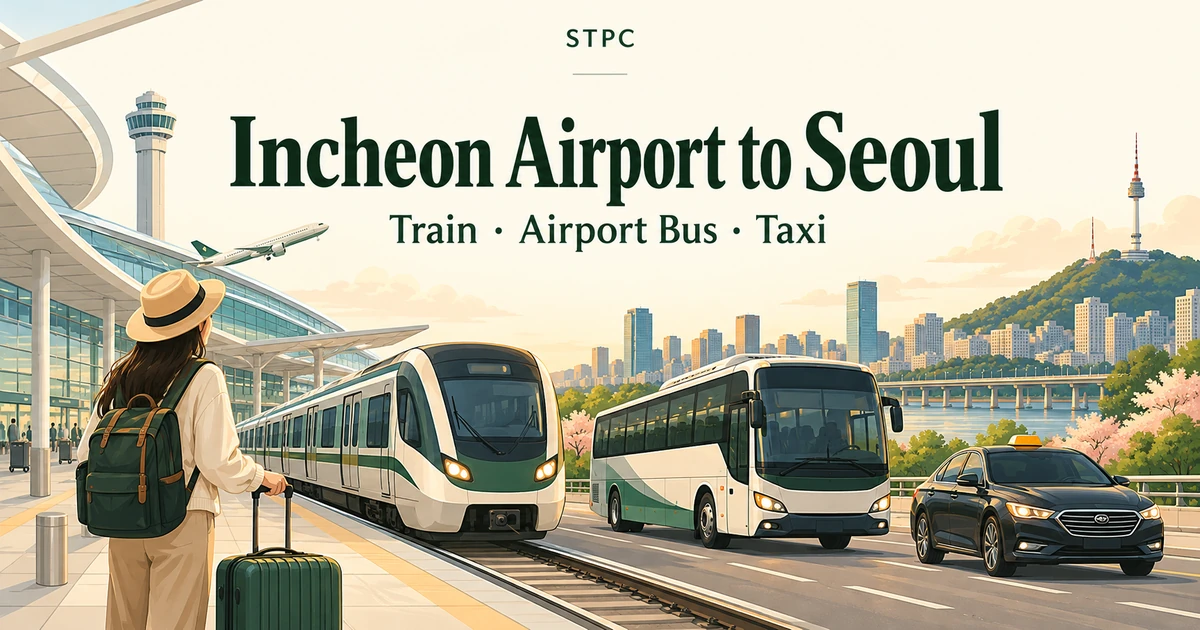
Choose the trip to your actual hotel, not just to Seoul Station. Compare AREX Express and All-Stop trains, airport buses and official taxis using current operator guidance, with terminal-specific ticket rules and late-arrival options.
Information checked: 2026-10-20
Information checked: October 20, 2026. Unless noted, prices are adult one-way fares in Korean won (KRW). All departure times use Korea Standard Time (KST), in the 24-hour clock. This guide covers Incheon Airport Terminal 1 (T1) and Terminal 2 (T2), rather than Gimpo Airport.
Check your travel date before relying on a train time. AREX has announced a complete timetable revision for both Express and All-Stop trains effective October 23, 2026. The late-night table below is explicitly for that new timetable. Use the applicable current schedule for earlier trips. Official AREX notice and downloadable timetables
1. Compare the trip to your hotel, not just the trip to Seoul Station
Start with your arrival terminal and the hotel’s complete address. Add the time needed to clear immigration, collect bags and complete customs before choosing a departure. The airport advises allowing for roughly 1–2 hours for arrival procedures when booking ground transportation; an individual arrival can take longer. A flight’s scheduled landing time is not a ready-to-board time. Incheon Airport’s bus guidance
| Option | Adult fare benchmark | What the travel time means | Useful when |
|---|---|---|---|
| AREX Express | KRW 13,000; separate train ticket | About 43 minutes from T1 or 51 from T2 to Seoul Station, plus waiting and onward travel | You want a reserved seat or are heading to Seoul Station |
| AREX All-Stop | T1–Seoul Station KRW 4,750; T2–Seoul Station KRW 5,350 with a transit card | About 59 or 66 minutes; some trains take 2–6 minutes longer | You are staying near Hongik University or Gongdeok, or prioritize cost |
| Airport limousine bus | The representative routes below cost KRW 17,000 or 18,000 | Depends on traffic, intermediate stops and the walk from the bus stop | A useful stop is close to your hotel |
| Taxi | Metered fare or a separately confirmed flat-fare service | Depends on the taxi queue and road conditions | You need fewer transfers or have cumbersome luggage |
Rail journey times start when the train leaves. They exclude the walk from arrivals, the wait for a train and the final trip to your hotel. The Express fare here is the operator’s displayed adult selling price on the check date; a member-only or promotional price is not assumed for every visitor. Express overview, All-Stop overview, fare table
For Hongdae/Hongik University or Gongdeok, check the All-Stop service before routing yourself through Seoul Station. For Myeongdong, compare a Seoul Station connection to subway Line 4 against the walk from an airport-bus stop. For City Hall or Jongno, the exact hotel location determines which connection works. For Gangnam or COEX, compare a connecting rail trip with a bus serving that particular neighborhood; “downtown Seoul” is too broad a destination for a useful quote.

2. Rail: choose the right AREX service and ticket
Express Train: reserved seating to Seoul Station
The Express serves the airport terminals and Seoul Station. It does not stop at Hongik University or Gongdeok. Follow the airport-railroad signs toward the B1 Transportation Center, then identify the Express ticketing and gate area rather than assuming any AREX gate accepts your ticket. Airport railroad location guide
- Confirm whether your starting station is T1 or T2.
- Choose a departure you can actually reach after arrival formalities.
- Purchase or redeem the appropriate ticket and confirm the train and seat assignment.
- Enter through the Express gate and use your assigned seat.
- At Seoul Station, continue to your actual hotel by subway, taxi or walking.
A third-party voucher is not automatically a reservation for the train you happen to want. Follow its redemption and seat-selection instructions. The official booking page also lists member and concession fares separately. Do not assume a U.S. senior or disability credential qualifies for a Korean concession. Wheelchair seats are sold at the station, according to the official reservation page; contact the operator in advance if you need one. Official Express reservations
All-Stop Train: direct access to intermediate neighborhoods
The All-Stop Train calls at Hongik University, Gongdeok and other stations along the airport line. Use the All-Stop gate and a valid ticket or Korean transit card. These are the operator’s adult transit-card fares for the specific destinations:
| Destination | From T1 | From T2 |
|---|---|---|
| Seoul Station | KRW 4,750 | KRW 5,350 |
| Hongik University | KRW 4,650 | KRW 5,250 |
| Gongdeok | KRW 4,650 | KRW 5,250 |
For an adult single-use transit card, add KRW 100 to the applicable fare and pay a refundable KRW 500 deposit. After leaving the gate at your destination, use the deposit-refund machine. If you are continuing onto the subway, select and check the fare to your final destination rather than treating a Seoul Station fare as the entire hotel transfer. AREX fares and deposit rules
You can buy a single-use AREX ticket with an overseas-issued credit card, according to the Korea Tourism Organization. That does not make the credit card itself a tap-to-enter subway ticket. Use the single-use card you purchased, or a valid Korean transit card, at the gate. Check the balance and top-up payment method separately if you choose a rechargeable card. A card payment failure at one machine is a reason to ask at the official counter and use a supported payment method. Official credit-card ticket guidance
Useful connections include subway Lines 5 and 9 at Gimpo Airport, Lines 5 and 6 at Gongdeok, and Line 2 at Hongik University. With heavy bags, allow time for elevators and connecting passages. Late at night, read the train’s actual destination: a train traveling toward Seoul may terminate before Seoul Station.
Where a transit-card tap is enough to board
Here, a transit card means a regular prepaid Korean card, such as Tmoney, accepted by the specific service. It does not mean any overseas credit card or a time-limited product such as the Climate Card.
| Trip | Board with a regular transit-card tap? | What to do first |
|---|---|---|
| AREX All-Stop | Yes | Check the fare balance and use the All-Stop gate |
| AREX Express | A regular card alone is not an Express ticket | Obtain a separate ticket and confirm train and seat |
| Airport Limousine 6001/6002/6015, T1 to Seoul | Yes | Join the first-come queue and confirm route and stop |
| Those Airport Limousine routes, T2 to Seoul | Boarding ticket required first | Buy it at the ticket counter or machine |
| K Airport Limousine 6701/6703, airport to Seoul | Boarding ticket required first | Buy the required ticket; exchange a QR voucher at a staffed counter |
AREX publishes separate instructions for buying and reloading All-Stop prepaid cards. Bus conditions depend on the operator, direction and terminal. Do not read K Airport Limousine’s general card-payment information as permission to skip ticketing at the airport. City-to-airport arrangements are a separate case. AREX ticket guidance, Korean, Airport Limousine boarding rules, Korean, K Airport Limousine ticket rules, Korean
Buy and load a prepaid card at the airport
- Buy the card. AREX identifies station convenience stores and transit-card vending machines as sales points. Check stock, opening hours and acceptance on your route. KTO lists ordinary Tmoney cards at KRW 3,000–5,000; designs and products can cost differently.
- Separate the card price from travel credit. Paying for the physical card does not automatically add the same amount as fare balance. Check whether a specific package includes any credit; load travel funds separately on an ordinary prepaid card.
- Have Korean won cash for the usual top-up. KTO lists cash for ordinary physical Tmoney purchases/top-ups at convenience stores and stations. Buying a rail ticket with an overseas credit card does not mean that card can also top up Tmoney there. Apps and special products have separate payment conditions.
- Load at a supported ticket machine or convenience store. Follow the machine's top-up instructions, place the card on the reader and add the amount. Wait for completion and check the balance. At a store, tell the cashier the amount and follow their instructions. Collect the card, change and receipt.
- Keep enough for the actual fare. On All-Stop trains, use the same card at entry and exit. For a bus accepting card boarding, confirm the route and destination and follow the driver's or staff's payment instructions. A funded card does not reserve a seat on a full coach.
Short-term visitors can buy and use an ordinary prepaid transit card without opening a bank account. Do not confuse it with mobile or postpaid products that may require Korean identity verification, a local phone number or other eligibility. KTO card purchase guide and ordinary card prices, KTO official payment-method chart, PDF
For card selection, buying, reloading, transfers and balance refunds, read Korea Transit Cards: Buying, Reloading, Transfers and Refunds alongside the airport-specific ticketing rules above.
3. Airport buses: match the actual stop to your hotel
An airport limousine is a scheduled coach service. Choose it by the hotel-to-stop walk and the correct direction, not by a promise that the route serves every hotel in a district.
| Route and operator | Areas to check | Adult one-way fare |
|---|---|---|
| 6001, Airport Limousine | Seoul Station, Myeongdong, Dongdaemun | KRW 17,000 |
| 6002, Airport Limousine | Hongdae, Jongno, Dongdaemun, Cheongnyangni | KRW 17,000 |
| 6015, Airport Limousine | Mapo, Gongdeok, Myeongdong, Euljiro | KRW 17,000 |
| 6701, K Airport Limousine | City Hall and Gwanghwamun | KRW 18,000 |
| 6703, K Airport Limousine | Sinnonhyeon, Gangnam and COEX | KRW 18,000 |
On the operator’s page, select the airport-to-city direction, then your terminal and the intended drop-off stop. Return-trip stops can be in a different location. Traffic affects the journey, so compare live routing to the same hotel address and departure time rather than assigning every bus a fixed “one-hour” arrival. 6001 · 6002 · 6015 · 6701 · 6703
Boarding floors, stops and operating windows
The following airport-origin details were checked by selecting each terminal on the operator’s page on October 20, 2026. Check your issued ticket, departure display and current signs for any temporary change.
| Route | T1 stand / first–last departure | T2 stand / first–last departure |
|---|---|---|
| 6001 | 1F, 5B-4 / 05:29–23:09 | B1, stand 29 / 05:39–22:49 |
| 6002 | 1F, 6A-1 / 05:34–23:29 | B1, stand 30 / 05:14–23:09 |
| 6015 | 1F, 5B-2 / 05:39–23:19 | B1, stand 28 / 05:19–22:59 |
Some T1 departures start earlier than the first T2 departure; do not derive one terminal’s entire timetable by adding a fixed time to the other. These are departures from the airport, not times for a return flight. Terminal 1’s bus facilities are on 1F; Seoul-bound buses at Terminal 2 use the B1 Transportation Center. T1 ticketing and stop information, T2 information
Ticket rules differ by terminal and operator
For Airport Limousine routes 6001, 6002 and 6015 at T1, the operator allows first-come boarding with cash, an accepted transit card or a bus ticket. At T2, buy a ticket first. Do not extend the T1 exception to every route or night service. Check ticket-holder priority and the instructions for the bus you are using. Operator passenger guidelines
For K Airport Limousine airport departures, get the required boarding ticket before boarding. A partner QR voucher must be exchanged at a staffed ticket counter, not a self-service kiosk, under the operator’s published instructions. Ticket rules and real ticket-office photos
The official photos show BUS TICKETS signs, a staffed counter and adjacent machines. The accompanying directions identify T1’s indoor ticket area beside Gate 4 on 1F and T2’s B1 Transportation Center. Use the photos to recognize the facilities; if exchanging a QR voucher, find the staffed counter rather than stopping at the machines. Photographs are not a substitute for the current platform printed on your ticket.
Baggage rules matter if you have more than one large suitcase
Airport Limousine’s published standard allowance is two pieces per person, each under 28 inches and under 20 kg, with combined length, width and height no more than 158 cm. Large carry-on bags count toward the allowance too. The latest passenger guidelines separately limit heavy or oversized luggage, including bags of 20 kg or more or over 28 inches, to one piece per person. A KRW 8,000 charge is listed per extra piece beyond the free allowance. Bicycles cannot be loaded. Keep fragile items under your own care and check oversized bags in advance. Apply the actual company’s policy if using another operator. Baggage policy, current passenger guidelines
4. Taxis: confirm the fare system and vehicle before loading
A taxi can take you to the hotel’s actual address, reducing transfers. It remains subject to road congestion. At either terminal, use the official 1F taxi stands and ask for the Seoul-bound queue or your confirmed reserved pickup. The airport specifically warns about solicitation and vans presenting themselves as taxis. A call van and a licensed taxi may use different service and fare rules. Airport taxi guidance
Seoul’s standard sedan taxi has a daytime starting fare of KRW 4,800 for 1.6 km. This is not the total fare to Seoul. The meter increases with distance and slow travel, and applicable tolls need to be accounted for. The standard Seoul sedan’s night surcharge is 20% from 22:00–23:00 and 02:00–04:00, and 40% from 23:00–02:00. Deluxe, larger and branded vehicles have their own fare systems. Seoul’s official taxi fare table
Incheon Airport is a joint taxi operating area for Seoul, Incheon and certain neighboring cities. The airport states that a qualifying trip from Incheon Airport to Seoul has no boundary surcharge. That does not remove a night surcharge or tolls.
International Taxi is an additional option for foreign visitors who need language assistance. Seoul’s official sedan International Taxi zonal table lists Mapo at KRW 75,000, Jung/Jongno at KRW 85,000 and Gangnam at KRW 90,000. These are reference prices for that separate service, not a universal flat fare for every cab. Confirm the terminal, vehicle, exact address and all included or additional charges before booking. Ordinary taxi fares should not be confused with an International Taxi product simply because a passenger is foreign.
Before loading, confirm:
- A metered trip or the exact name and total price of a separate approved fare plan.
- The hotel's full address, not just a similar hotel name.
- Tolls, night charges, booking fees and any waiting charges.
- Enough legal passenger seating and space for all luggage.
- An accepted payment method and a receipt.
For a transparent group comparison, four adults paying KRW 17,000 each spend KRW 68,000 on the bus; four Express tickets cost KRW 52,000. Four adult transit-card fares to Seoul Station total KRW 19,000 from T1 or KRW 21,400 from T2. These calculations exclude onward travel, card purchases, deposits and any baggage charges. Compare the complete total with a confirmed taxi quote, and do not assume four adults plus four large cases fit a standard sedan.
5. Late arrivals: check where the last train actually ends
Airport departures under the timetable effective October 23
These first and last departures were checked against AREX’s October 23, 2026 official PDF, including the weekday and holiday sheets. For travel through October 22, use the timetable applicable to that earlier date.
| Service | T1 departure | T2 departure |
|---|---|---|
| First Express to Seoul Station | 05:24 | 05:16 |
| Last Express to Seoul Station | 22:48 | 22:40 |
| First All-Stop to Seoul Station | 05:14 | 05:08 |
| Last All-Stop to Seoul Station | 23:38 | 23:32 |
| Final All-Stop, ending at DMC | 23:56 | 23:50 |
DMC is Digital Media City, not Seoul Station. Reaching DMC does not guarantee a connecting subway service. Even the last train that reaches Seoul Station does not guarantee an onward train to Myeongdong, City Hall or Gangnam. Check the final connection separately and allow for arrival procedures, walking and the gate closing before departure. Dated revision notice and attachments, official Express timetable
Night buses after rail service ends
| Route | Main direction | Adult fare listed by the airport |
|---|---|---|
| N6000 | Gangnam Express Bus Terminal | KRW 17,000 |
| N6002 | Hongdae, Gwanghwamun, Dongdaemun, Cheongnyangni | KRW 17,000 |
| N6701 | Mapo, Seoul Station, Euljiro Entrance, DDP | KRW 18,000 |
| N6703 | COEX, Jamsil, Gangbyeon and Gwangnaru direction | KRW 18,000 |
Night buses have gaps between departures, and the stop may still be far from your hotel. Check the next actual departure from your own terminal, seat availability and the final local trip. For Seoul Station, choose a route that really calls there, such as N6701; a “Seoul-bound” sign alone is not enough. T1 night buses, T2 night buses
If the remaining service cannot get you near your hotel, compare an official taxi or ask the airport and accommodation about available alternatives. Do not plan to skip any arrival formalities to reach a last departure.
6. Children, accessibility and luggage can change the best choice
Rail avoids road congestion, but elevators, gates and transfers still require moving your bags. A bus’s luggage hold can help, yet the last stop-to-hotel walk may include stairs or crossings. A taxi reduces transfers, but suitable seating, luggage capacity, child restraints or accessibility support must be checked for the actual vehicle.
Search the hotel’s entrance and a usable station exit, not just the nearest station name. This guide does not assume you have a Korean residence card, domestic identity verification, a Korean phone number or a locally issued payment card. If an app requires something you do not have, use the operator’s official station counter, bus ticket desk or taxi assistance point to confirm an available purchase or pickup method. Child fares and assisted services have their own age, evidence and reservation requirements.
Before you leave arrivals
- Save the terminal, full hotel address and contact information.
- Identify a reachable departure and its real terminus.
- Check whether you need an Express ticket, transit card, bus ticket or QR-voucher exchange.
- Count and measure bags; check the final walk and transfers.
- Save an official night-bus or taxi fallback if you miss the planned service.
For the steps before reaching arrivals—and for your eventual flight out—continue with our published South Korea entry and exit checklist for U.S. travelers. This transport guide begins after you have completed immigration, baggage collection and customs.
The AREX and bus-company source links in this guide open Korean-language pages. Airport, Seoul and Korea Tourism Organization references are in English.
Information checked: October 20, 2026. The revised rail table takes effect October 23, 2026. Recheck operating information, fares and stops for your travel date.
답글 남기기